
Growing Tourism — and Making It Count for Downtown
Front Royal has something many towns would love to have: the northern entrance to Shenandoah National Park.
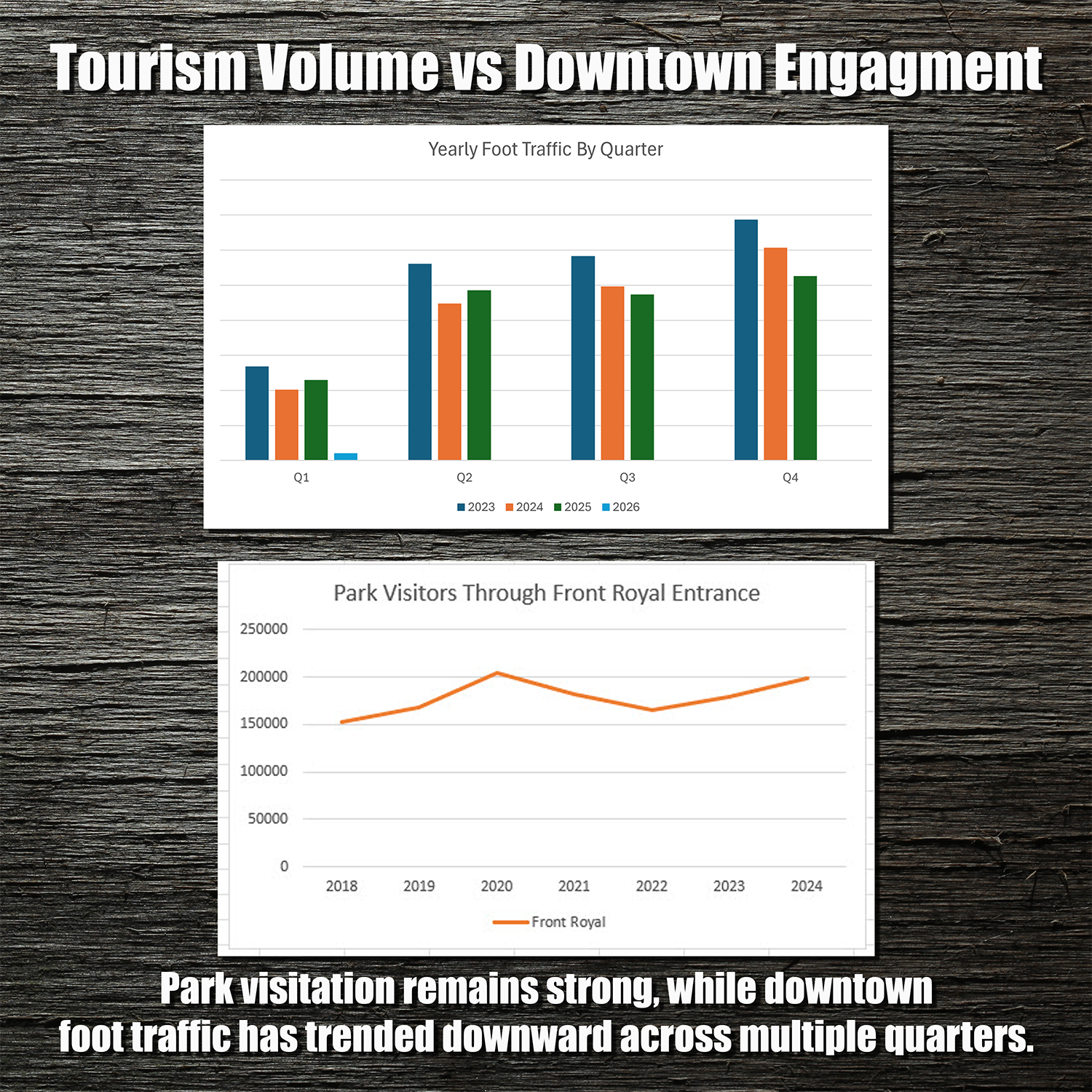
Comparison of Shenandoah National Park visitation through the Front Royal entrance and quarterly downtown foot traffic trends.
Park visitation through the Front Royal entrance remains strong and has rebounded near historic highs in recent years. That’s a tremendous asset for our community and something worth continuing to grow.
Increasing visitor volume absolutely matters. More visitors create opportunity.
But visitor volume alone does not guarantee downtown economic impact.
At the same time that park visitation has remained strong, downtown in-store foot traffic has trended downward across multiple quarters in recent years — including Q3 and Q4, which are traditionally our peak tourism seasons.
That contrast raises an important question:
How do we not only increase visitors — but also ensure more of them engage with Main Street?
Tourism Has Evolved
Visitor behavior today looks different than it did 10–15 years ago.
Many visitors stay in short-term rentals and cook at home.
Many use Google to go directly to one or two destinations.
Outdoor recreation is often the primary focus.
Event-based spikes don’t necessarily translate into steady everyday foot traffic.
The old assumption was that visitors would naturally wander downtown. That’s no longer automatic.
If we want a strong Main Street, we need both:
Continued growth in tourism
Stronger conversion of visitors into downtown engagement
Volume and Conversion Are Both Necessary
Economic impact doesn’t come from volume alone.
It comes from:
Visitor Growth
×
Downtown Awareness
×
Engagement
×
Spending
If we focus only on attracting more people but don’t intentionally connect them to downtown, we leave opportunity on the table.
If we focus only on downtown without growing overall visitation, we limit our ceiling.
The goal should be both.
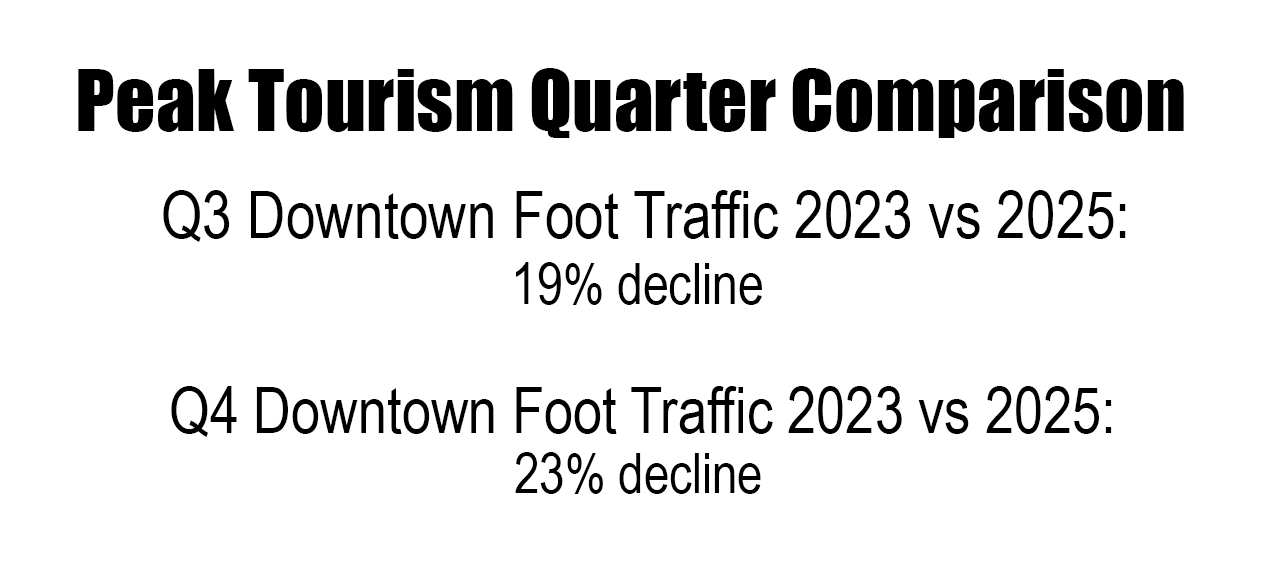
Peak tourism quarter comparison of downtown foot traffic, 2023 vs. 2025.
If tourism volume is strong, that strength should be most visible during peak seasons. Looking specifically at Q3 (summer hiking season) and Q4 (fall foliage and holiday traffic) provides additional clarity.
These declines suggest that even during our strongest tourism periods, downtown engagement has softened compared to 2023.
The Missing Middle
Right now, we have good data on park entry numbers.
We have directional data on downtown foot traffic.
What we don’t have strong visibility into is the space in between:
What percentage of park visitors come into town?
How many are day-trippers vs. overnight stays?
How are visitors discovering restaurants and shops?
Are lodging partners actively directing guests to Main Street?
That middle section — the connection between arrival and engagement — is where economic development lives.
This Isn’t About One Business
This isn’t about any single store.
A healthy downtown supports:
Local jobs
Property values
Sales tax revenue
Investment confidence
Community identity
When downtown is vibrant, the entire community benefits.
A Constructive Path Forward
Rather than debating whether tourism matters, perhaps the more productive question is:
How do we grow visitation — and design a stronger system that connects those visitors to the heart of our town?
That may involve:
Continued regional tourism marketing
Clearer downtown visibility online
Stronger coordination with hotels and STR hosts
Better measurement of visitor behavior
More intentional “park-to-downtown” pathways
Front Royal has the natural assets.
We have the park entrance.
We have restaurants, shops, history, and character.
The opportunity isn’t choosing between more visitors or downtown engagement.
It’s building a strategy that strengthens both.
Growing tourism is important.
Converting tourism into local economic impact is essential.
If we agree that tourism growth and downtown vitality both matter, then the next step is alignment.
This isn’t about criticism — it’s about coordination.
Growing visitation is important. Designing stronger pathways from park arrival to downtown engagement is essential.
That’s a conversation worth having — and one I believe our community is capable of having thoughtfully.
More from Scott Turnmeyer
I write about photography, business, mindset, bowling, and the bigger questions that don’t always have easy answers. You can explore more articles, photography, and projects here:
Blog Home
About Scott Turnmeyer
Fine Art Photography
Photography Workshops & Experiences
Digital Consulting