
Tourism Is More Than Marketing: A Framework for Growing the Visitor Economy in Warren County and the Town of Front Royal
Over the past several weeks, both Warren County and the Town of Front Royal have seen renewed discussions about the future of tourism and how our destination should be promoted, managed, developed, and measured.
I welcome those conversations.
Tourism is one of the largest economic opportunities available to our community. Every visitor who spends the night, enjoys dinner downtown, purchases locally made products, books an outdoor adventure, or returns for another weekend directly supports local jobs, businesses, tax revenues, and quality of life.
I believe these conversations are healthy. They encourage us to ask an important question:
What does tourism success actually look like?
Unfortunately, I also believe many communities—including our own—often begin that conversation in the wrong place.
Too often we jump directly into discussing websites, social media, advertising, brochures, visitor guides, or marketing budgets before first defining what tourism is supposed to accomplish.
Marketing is certainly part of tourism.
But marketing is not all of tourism.
One Destination. Two Governments.
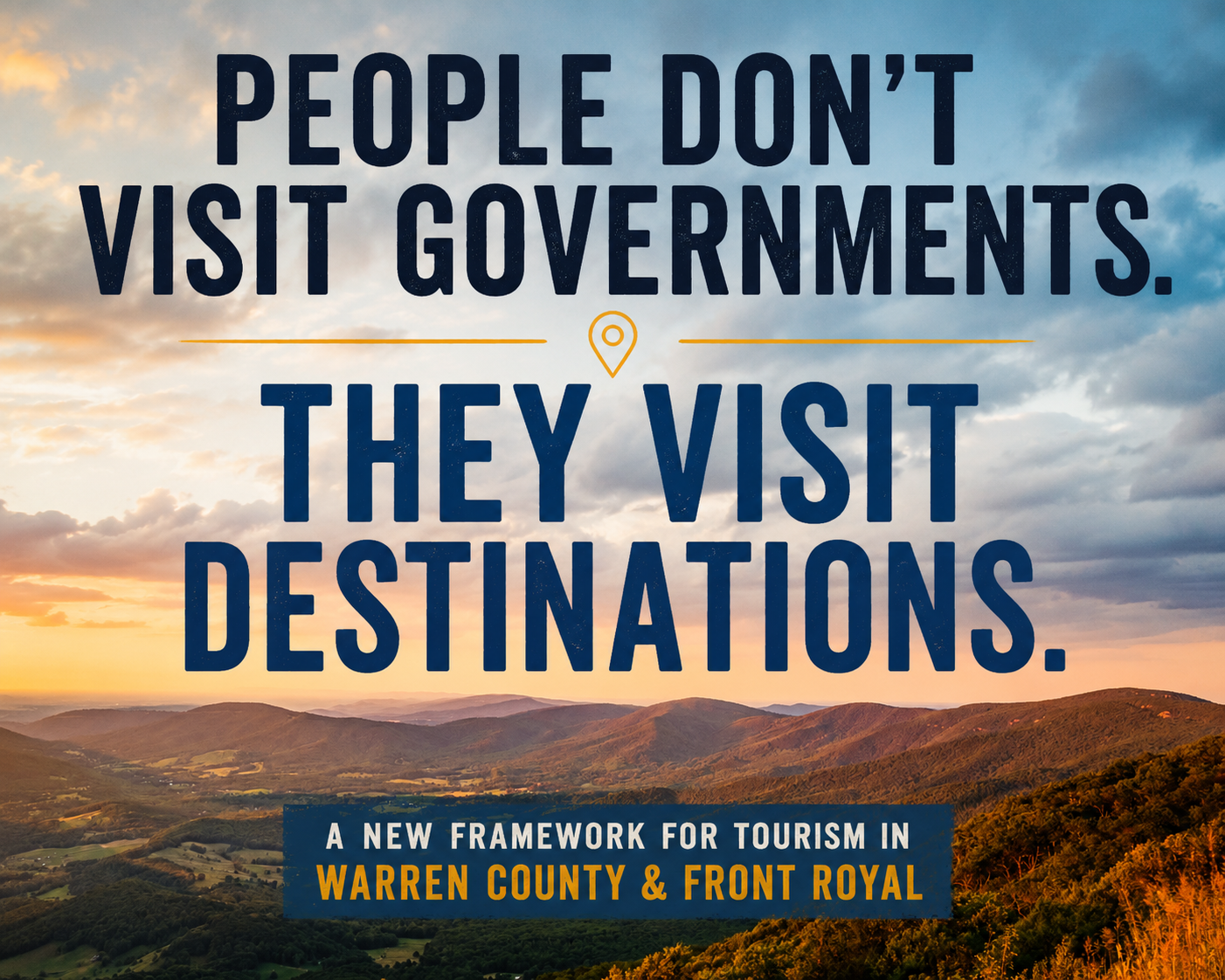
One of the realities that makes tourism unique is that visitors don't experience governments.
They experience destinations.
A family driving from Northern Virginia doesn't tell their children they're spending the weekend in "The County of Warren" or "The Town of Front Royal."
They simply say they're going to Front Royal.
Or Shenandoah National Park.
Or Skyline Drive.
Or the Shenandoah River.
To a visitor, these experiences are inseparable.
They drive through our gateway community.
They eat in our restaurants.
They hike our trails.
They paddle our rivers.
They stay in our hotels and vacation rentals.
They shop in our locally owned businesses.
They attend events throughout both the Town and the County.
Visitors experience one destination.
Our tourism strategy should reflect that same reality.
Tourism Is Much Bigger Than Marketing
Much of today's tourism discussion centers around marketing.
Should we advertise more?
Should we invest in social media?
Should we improve our website?
Should we produce more videos?
Should we create more content?
The answer to all of those questions is probably yes.
But they're also secondary questions.
The first question should be:
What are we trying to accomplish?
The purpose of tourism is not to generate likes.
It is not to increase website traffic.
It is not to grow Facebook followers.
Those are marketing activities.
The purpose of tourism is to strengthen our local economy.
Tourism should increase visitor spending.
Tourism should create jobs.
Tourism should support small businesses.
Tourism should increase overnight stays.
Tourism should improve tax revenues.
Tourism should encourage visitors to return.
Marketing exists to help accomplish those objectives—not replace them.
Marketing Metrics Are Inputs. Economic Results Are the Scorecard.
One of the biggest mistakes communities make is confusing marketing performance with tourism performance.
Every destination should absolutely measure:
Website traffic
Search rankings
Advertising performance
Social media engagement
Email growth
Media coverage
Those metrics help marketers understand whether campaigns are working.
But they are not the scorecard.
Imagine a business owner proudly announcing that an advertising campaign reached one million people, yet annual sales never increased.
Would anyone consider that campaign successful?
Probably not.
Tourism should be evaluated the same way.
The ultimate measure of success isn't how many people saw our content.
It's whether that awareness translated into measurable economic activity.
That means asking different questions.
Is our Transient Occupancy Tax increasing?
Is Meals Tax revenue growing?
Has hotel occupancy improved?
Are visitors staying longer?
Are downtown businesses seeing increased visitor spending?
Has retail sales tax grown?
Are visitors returning?
Those are the numbers that matter.
Those are the numbers taxpayers deserve to see.
Destination Development: The Conversation We Aren't Having
If marketing brings people here, destination development gives them reasons to stay.
This is where I believe our community has one of its greatest opportunities.
Destination development isn't advertising.
It's building experiences.
It's asking questions like:
How do we encourage the 2 million Shenandoah National Park visitors to spend an evening downtown instead of driving home?
How do we encourage someone staying one night to stay two?
How do we help visitors discover attractions beyond Skyline Drive?
How do we connect outdoor recreation with local restaurants, breweries, wineries, shopping, and events?
How do we create experiences that visitors can't find anywhere else?
Those are destination development questions.
They involve infrastructure.
Business partnerships.
Experience creation.
Wayfinding.
Events.
Trails.
Public spaces.
Agritourism.
Arts.
Culture.
Outdoor recreation.
Visitor itineraries.
None of those things can be solved solely through advertising.
Collaboration Creates More Value Than Duplication
One of the questions that continually surfaces whenever tourism funding is discussed is this:
Should Warren County market tourism?
Or should the Town of Front Royal?
I believe that is the wrong question.
The better question is:
How can both organizations work together to create a stronger destination than either could build independently?
Public resources are limited.
That means every tourism dollar should create the greatest possible economic return.
When two organizations spend public money performing the same task, taxpayers receive less value than when each organization specializes in what it does best. And when you say you are marketing just certain assets I would remind you that our visitors don’t see lines. Someone looking on the County’s tourism site might want to know about downtown shopping or walkable spaces. They would not see our amazing Downtown Front Royal because it’s not marketed there. Doesn’t it make sense to have 1 source of truth? I believe it does.
Collaboration should never mean duplication.
It should mean complementary responsibilities.
Every dollar spent producing two visitor guides, maintaining two overlapping marketing campaigns, or advertising to the same audience twice is a dollar that cannot be invested in improving our destination.
Imagine instead a system where one organization focuses on attracting visitors while the other focuses on giving those visitors more reasons to stay.
Those efforts don't compete.
They strengthen one another.
Let the Data Help Guide the Conversation
One place where specialization becomes especially interesting is search behavior.
Using Google's Keyword Planner and analyzing search activity from the previous twelve months within approximately a five-hour driving radius of Warren County reveals a significant difference in how potential visitors search for our destination.
The phrase "Front Royal Virginia" averages approximately 40,500 searches every month.
By comparison, "Warren County Virginia" averages approximately 2,400 monthly searches.
Perhaps even more interesting is the trend.
Between the 2024–2025 and 2025–2026 reporting periods, searches for "Front Royal Virginia" increased from approximately 33,100 searches per month to 40,500.
During that same period, searches for "Warren County Virginia" remained essentially flat at approximately 2,400 monthly searches.
This isn't about one government being more important than another.
It's about understanding consumer behavior.
The marketplace has already told us which destination brand visitors recognize first.
From a marketing perspective, investing additional public dollars to build awareness around a search term used by only 2,400 people each month may not produce the same return as continuing to strengthen a destination brand already searched more than sixteen times as often—and one that continues to grow.
That doesn't diminish Warren County's role.
In fact, I would argue it strengthens it.
Rather than duplicating destination marketing efforts, Warren County has an opportunity to invest its tourism resources where they can create the greatest long-term value: destination development.
Instead of spending additional dollars trying to reach the same audience already searching for Front Royal, imagine investing those dollars into creating new visitor experiences, improving infrastructure, strengthening partnerships, supporting local businesses, and converting more Shenandoah National Park visitors into overnight guests.
Marketing and destination development are not competing priorities.
They are complementary disciplines.
When each organization focuses on its strengths while sharing a common vision and common measurements of success, taxpayers receive greater value, businesses receive greater support, and visitors enjoy a stronger destination experience.
Measuring What Actually Matters
If tourism is an investment, then it should be managed like one.
Every year, both Warren County and the Town of Front Royal invest public dollars into growing our visitor economy. Like any investment, taxpayers should expect measurable results—not assumptions.
That begins with asking the right questions.
Not:
How many Facebook followers did we gain?
How many people liked a post?
How many people viewed a video?
Those are useful marketing metrics, but they are operational metrics. They tell us how our marketing performed—not whether our tourism strategy succeeded.
The metrics that matter most are economic.
A community-wide tourism dashboard should be published annually and reviewed publicly by both the Warren County Board of Supervisors and the Front Royal Town Council. It should include measurable indicators that demonstrate whether tourism is producing real economic value.
Examples include:
Economic Performance
Transient Occupancy Tax collections
Meals Tax collections
Retail Sales Tax growth
Hotel Occupancy Rate
Average Daily Rate (ADR)
Revenue Per Available Room (RevPAR)
Average Length of Stay
Estimated Visitor Spending
Tourism Employment
New Tourism Business Investment
Destination Development
Number of new visitor experiences launched
Public-private partnerships created
Tourism grants secured
Wayfinding projects completed
New attractions or amenities developed
Event attendance
Business participation in tourism initiatives
Visitor satisfaction surveys
Business satisfaction surveys
Destination Marketing
Website traffic
Organic search growth
Campaign return on investment
Visitor Guide requests
Email engagement
Public relations placements
Digital advertising performance
Marketing should never be evaluated independently of economic outcomes.
Its purpose is to create those outcomes.
Destination Management Requires Accountability
One of the greatest opportunities for our community is not simply deciding who should perform tourism functions.
It is defining exactly what those functions are, assigning responsibility for each one, and measuring whether they are producing results.
That's where I believe a formal Memorandum of Understanding (MOU) between Warren County and the Town of Front Royal could become transformational.
Instead of debating who "owns" tourism, an MOU would answer much more important questions:
Who is responsible for what?
How is success measured?
What are the annual goals?
How is performance reported?
How do both organizations work together instead of duplicating effort?
Below are two governance models that could accomplish that goal.
Option One
Shared Leadership Through Specialization
In this model, Warren County and the Town of Front Royal each lead the areas where they can provide the greatest value while sharing a common vision, common measurements, and common economic goals.
For background, the Transient Occupancy Tax is collected by the County and is referred to as the lodging tax. It is 5%. 3 of that 5% must be reinvested into tourism while the remaining 2% moves into the General Fund and can be spent on whatever the Board of Supervisors deem necessary. Right now there is roughly $21M spent annually on lodging, that equates out to roughly $630,000 back into tourism and roughtly $420,000 in tax revenue into the General Fund.
Funding
Warren County allocates approximately 33% of the annual tourism funding generated through the mandated Transient Occupancy Tax to the Town of Front Royal to lead destination marketing.
The remaining funding is retained by Warren County to lead destination development throughout the destination.
Why This Model Works
This model recognizes that marketing and destination development are two different disciplines requiring different expertise.
Rather than creating two organizations performing similar marketing functions, each organization specializes while supporting the other.
The Town builds awareness.
The County builds experiences.
Both organizations measure success using the same economic outcomes.
Town Responsibilities
Tourism Marketing
Brand management
Destination website
Search Engine Optimization
Paid advertising
Social media
Public relations
Visitor Guide production
Email marketing
Media relations
Visitor information services
Visitor Center
Cooperative marketing with local businesses
Quarterly marketing performance reports
County Responsibilities
Destination Development
Five-Year Tourism Strategic Plan
Annual Destination Development Plan
Tourism Advisory Board coordination
Stakeholder engagement
Experience development
Attraction recruitment
Event recruitment
Tourism grant development
Infrastructure recommendations
Wayfinding improvements
Trail and river access improvements
Public-private partnership development
Annual State of Tourism Report
Shared Annual Goals
Examples
Increase Transient Occupancy Tax by 5%
Increase Meals Tax by 4%
Increase hotel occupancy by 2%
Increase average visitor length of stay
Recruit three new visitor experiences
Complete three destination development projects
Secure at least one tourism grant annually
Increase repeat visitation
Conduct one annual tourism stakeholder summit
Quarterly Reporting
Both organizations would jointly present a public quarterly dashboard showing progress toward agreed-upon goals.
Success would no longer be measured independently.
Both organizations would succeed—or fail—together.
Advantages
Eliminates duplicated marketing efforts.
Allows each organization to specialize.
Encourages collaboration.
Creates measurable accountability.
Better utilizes limited public funding.
Challenges
Requires strong communication.
Requires shared strategic planning.
Success depends upon collaboration rather than competition.
Option Two
A Unified Destination Management Organization
This model places both destination marketing and destination development under one organization.
Funding
Warren County allocates 100% of the mandated tourism funding generated through the Transient Occupancy Tax to the Town of Front Royal.
The Town becomes the Destination Management Organization (DMO) responsible for tourism throughout both Warren County and the Town of Front Royal.
Why This Model Works
This model creates one organization responsible for every aspect of tourism.
There is no confusion over responsibilities.
Businesses have one point of contact.
Marketing and destination development operate under one strategic plan.
Performance is measured using one scorecard.
Tourism Marketing Responsibilities
Branding
Website
SEO
Paid advertising
Visitor Guide
Social media
Public relations
Email marketing
Visitor services
Visitor Center
Destination Development Responsibilities
Tourism Strategic Plan
Destination Development Plan
Tourism Advisory Board
Stakeholder engagement
Attraction recruitment
Experience development
Event recruitment
Wayfinding
Grant development
Visitor experience improvements
Business engagement
County Responsibilities
Even under this model, Warren County remains an essential partner by providing:
Tourism funding
Infrastructure coordination
Regional partnerships
Park partnerships
Transportation coordination
Public safety coordination
Capital project support
Annual Performance Contract
Funding would be tied to measurable outcomes.
Examples include:
Increase hotel occupancy by 2%
Increase Meals Tax revenue by 4%
Increase Transient Occupancy Tax by 5%
Increase average visitor length of stay
Complete three destination development projects
Launch two new visitor experiences
Recruit one major regional event annually
Publish four quarterly dashboards
Publish one Annual State of Tourism Report
Conduct annual visitor and business satisfaction surveys
Performance would be reviewed annually by both governing bodies.
If goals are consistently missed, strategies would be adjusted and responsibilities revisited.
Advantages
Single point of accountability.
Unified strategic direction.
Eliminates duplication.
Easier coordination with businesses and tourism partners.
Marketing and development operate together.
Challenges
Requires sufficient staffing.
Requires significant organizational capacity.
Places substantial responsibility on one organization.
Which Model Do I Prefer?
Personally, I believe the first model deserves serious consideration.
Not because one organization should have more authority than the other.
But because it recognizes that Warren County and the Town of Front Royal each bring unique strengths to the table.
The Town already represents the destination brand that consumers overwhelmingly recognize.
The County owns many of the natural assets, parks, infrastructure, and partnerships that shape the visitor experience.
Rather than duplicating marketing efforts, each organization could focus on strengthening the other.
The Town would continue telling our story.
The County would continue improving that story.
Together, both organizations would measure success using the exact same economic outcomes.
One Destination. One Visitor Economy.
Perhaps the most important shift our community can make is changing the question.
Instead of asking:
"Who should do tourism?"
We should ask:
"How do we organize ourselves to grow the visitor economy?"
Tourism is not about governments.
It is not about departments.
It is not about logos.
It is not about websites.
It is not even about marketing.
Tourism is about people.
People choosing to visit our community.
People staying another night.
People enjoying another meal.
People shopping in another locally owned business.
People returning with friends and family.
Every decision we make should ultimately support those outcomes.
Visitors don't know where the Town ends and the County begins.
Neither should our tourism strategy.
If Warren County and the Town of Front Royal can move beyond duplication and instead embrace collaboration, specialization, accountability, and measurable outcomes, I believe our community has the opportunity to become one of Virginia's strongest destination management success stories.
Not because one organization did more than the other.
But because both organizations worked together to build something neither could accomplish alone.
That, in my opinion, is what destination management should look like.
More from Scott Turnmeyer
I write about photography, business, mindset, bowling, and the bigger questions that don’t always have easy answers. You can explore more articles, photography, and projects here:
Blog Home
About Scott Turnmeyer
Fine Art Photography
Photography Workshops & Experiences
Digital Consulting