
How I Would Structure Tourism and Destination Development in Warren County
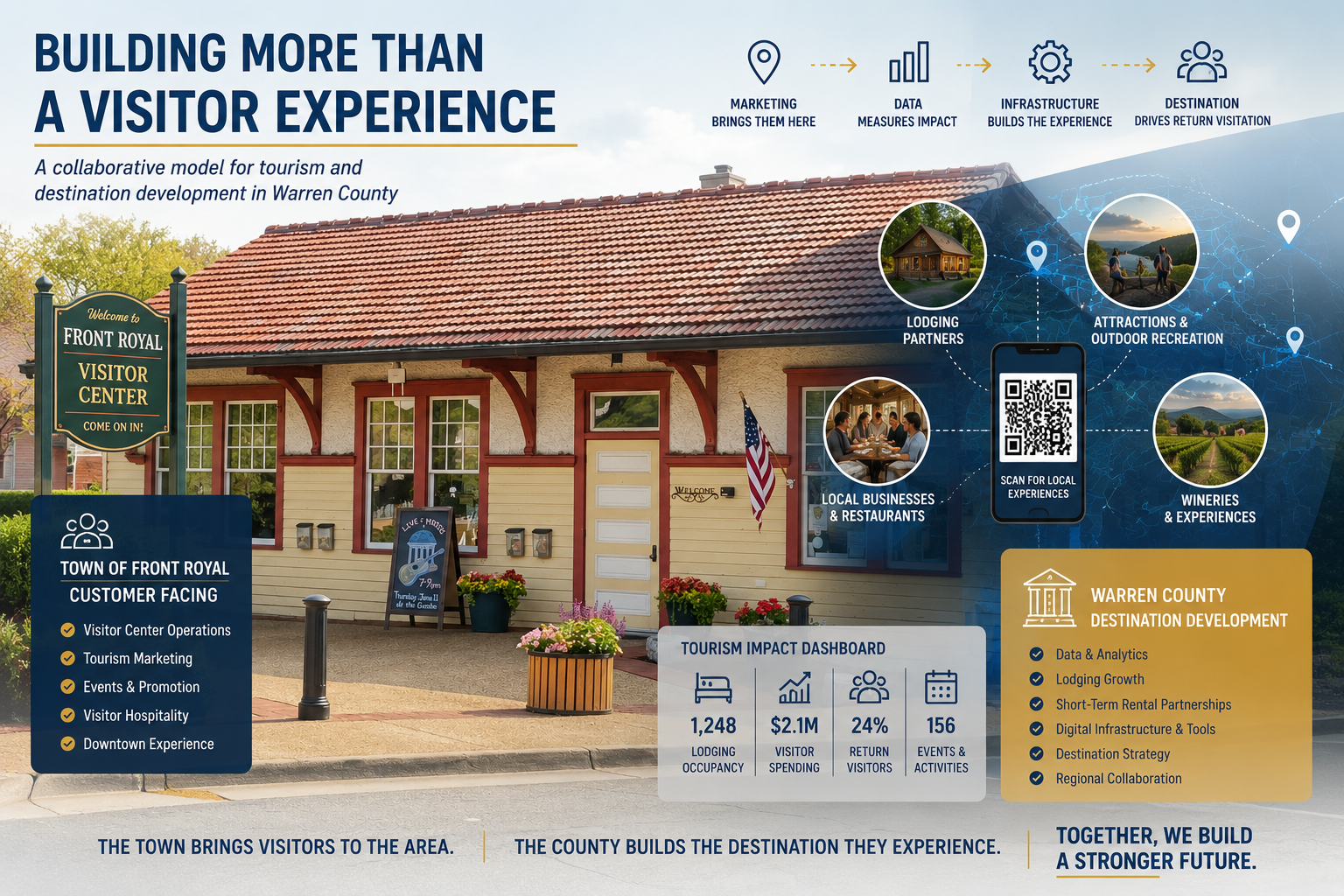
Sample data only for demonstration
Over the past several years, tourism conversations in Warren County and Front Royal have continued to grow, and for good reason. Tourism is one of the largest economic opportunities available to our community. We sit at the northern entrance to Shenandoah National Park and Skyline Drive, we have a vibrant downtown, outdoor recreation, wineries, small businesses, lodging partners, events, and one of the most recognizable tourism corridors in Virginia.
But I believe one of the biggest challenges in these conversations is that we often use the word “tourism” to describe two very different functions.
Those functions are:
Tourism operations and marketing
Destination development
Both are critically important, but they are not the same thing. How would I structure it if asked my opinion? This article goes through that.
The Town’s Role: Customer Facing Tourism Operations
The Town of Front Royal is uniquely positioned to handle the customer-facing side of tourism.
This includes:
Visitor center operations
Visitor hospitality
Tourism marketing
Event promotion
Downtown visitor experiences
Social media engagement
Day-to-day visitor communication
Website content and visitor information
The Town is the front door to the destination.
They are often the first interaction a visitor has when researching or arriving in the area. They are the customer-facing arm of tourism, and they should absolutely play a major role in welcoming visitors and marketing the community.
Tourism marketing matters. Bringing visitors to the area matters.
But marketing alone is not destination development.
The County’s Role: Building the Destination
Destination development is the back-end infrastructure of the visitor economy.
It is the long-term work that grows tourism as an economic development engine.
The County is the right entity to focus on building, coordinating, measuring, and growing the destination itself.
That includes:
Growing overnight stays
Increasing visitor spending
Building tourism infrastructure
Measuring tourism performance
Supporting countywide tourism assets
Coordinating regional partnerships
Developing long-term tourism strategy
Building systems that improve the visitor experience and increase return visitation
Tourism marketing brings visitors here.
Destination development gives them reasons to stay longer, spend more, and come back again and again.
Those are complementary functions, not competing ones.
One of the best ways I can describe the relationship is this:
Tourism is the marketing arm of destination development.
Marketing gets people interested.
Destination development builds the experience behind the marketing.
A visitor may come here because they saw Skyline Drive, Shenandoah National Park, or a social media campaign promoting Front Royal. But whether they return, what else they decide to explore, depends on the quality, convenience, coordination, and depth of the experience once they arrive.
The long-term success of tourism is not measured only by how many people visit once, but by how many visitors become repeat visitors who return year after year.
That is where destination development matters.
The Short-Term Rental Example
One example that perfectly illustrates the difference between tourism marketing and destination development is our growing short-term rental market.
Imagine a visitor arrives at an Airbnb or cabin rental in Warren County.
At that point, tourism marketing has already succeeded. The visitor is here.
Now the question becomes:
How do we improve their experience while they are here and increase the chances they return again in the future?
This is where destination development initiatives become important.
Many destinations across the country provide visitors with digital “coupon books” or experience guides that connect them directly to:
Restaurants
Attractions
Shops
Outdoor recreation
Events
Wineries
Activities
Today, technology allows this to happen digitally through QR codes, automated messaging, and mobile experiences.
Imagine every hotel room, short-term rental, campground, and lodging partner in Warren County having:
QR codes linking to local experiences
Digital visitor guides
Dynamic itineraries
Restaurant and attraction offers
Seasonal recommendations
Event calendars
Adventure packages
Regional visitor information
Who owns that initiative?
It is not traditional tourism marketing because the visitor is already here.
It is destination development.
It is building infrastructure that improves the visitor experience, supports local businesses, increases visitor spending, and drives repeat visitation.
Right now, that type of initiative does not clearly belong to anyone.
And that is the gap destination development fills.
Data and Analytics Matter
Destination development also requires measurement. A lot of measurement.
If tourism is truly an economic development initiative, then we should measure it the same way we measure other economic development efforts.
That means building dashboards and tracking:
Lodging occupancy trends
Meals tax growth
Visitor spending
Seasonal visitation patterns
Short-term rental performance
Website analytics
Conversion metrics
Event performance
Return visitation trends
Without data, tourism becomes reactive.
With data, tourism becomes strategic.
This type of analytical and infrastructure-focused work is often broader than what a traditional visitor center operation is designed to handle.
A Collaborative Model Works Best
This does not need to be an “either/or” conversation between the Town and County.
In fact, the best tourism systems are collaborative. It eliminates single points of failure instead of creating them.
The Town can successfully own and operate the customer-facing tourism experience while the County focuses on broader destination development strategy and countywide tourism growth.
The Town brings visitors to the area.
The County helps build the destination they experience once they arrive.
Together, those functions create a stronger tourism economy than either can build independently.
Front Royal is the brand, Warren County is the experience. You use your brand to attract, you use your experiences to get the most out of every visit and encourage repeats visitations.
Warren County and Front Royal Have a Major Opportunity
Warren County and Front Royal have tremendous tourism potential.
But tourism today is no longer just brochures and advertisements. Modern destination development requires:
Strategy
Analytics
Coordination
Technology
Visitor infrastructure
Regional collaboration
Long-term planning
The destinations that succeed long term are the ones that move beyond simply marketing themselves and begin intentionally building visitor ecosystems designed to create repeat visitors and sustainable economic growth.
I believe Warren County has the opportunity to become one of those destinations. Tourism can pay for those infrastructure needs that we currently are pinching pennies and raising taxes for. But we need to move. You cannot solve for 100% of the scenarios. You must solve for 80% to keep momentum while being flexible enough to handle the other 20% of the scenarios as you move.
If Warren County truly wants tourism to become one of its strongest economic drivers, the next step is moving beyond tourism marketing alone and intentionally building the destination experience behind it.
More from Scott Turnmeyer
I write about photography, business, mindset, bowling, and the bigger questions that don’t always have easy answers. You can explore more articles, photography, and projects here:
Blog Home
About Scott Turnmeyer
Fine Art Photography
Photography Workshops & Experiences
Digital Consulting