
Technology Always Finds Another Path
Throughout history, people have resisted change.
Sometimes that resistance is justified. Sometimes it is driven by legitimate concerns about quality of life, environmental impacts, or the preservation of a community's character. But one thing history repeatedly teaches us is that resistance rarely stops technological progress. Instead, technology does what it does best: it adapts, evolves, and finds another path.
Today, we are witnessing that pattern once again with data centers.
Across the United States, communities are increasingly pushing back against proposed data center projects. Concerns about energy consumption, water usage, noise, land development, and visual impacts have become common topics at public hearings and planning commission meetings. Residents who may have once welcomed economic development are now questioning whether large-scale data center campuses are the right fit for their communities.
At the same time, demand for computing power is exploding.
Artificial intelligence, cloud computing, autonomous systems, advanced scientific research, cybersecurity, and the billions of devices connected to the internet all require one thing: more computing capacity. Every AI model trained, every video streamed, every search performed, and every cloud application accessed depends on infrastructure that must exist somewhere.
This creates an interesting dilemma.
Communities may successfully stop individual projects. They may delay approvals, increase regulations, or reject proposed facilities altogether. Yet the demand for computing does not disappear simply because a local government says no.
The technology industry understands this reality.
And as it has done many times before, it is already beginning to engineer around the problem.
History Shows the Pattern
This is not the first time society has faced a conflict between technological advancement and local opposition.
Communities resisted railroads.
Railroads expanded.
Communities resisted highways.
Highways expanded.
Communities resisted cell towers.
Wireless networks expanded.
Communities resisted wind farms, transmission lines, and utility infrastructure.
Those technologies continued to evolve and spread.
In each case, the resistance influenced how and where the technology developed, but it rarely stopped development altogether.
Technology adapts.
Investors redirect capital.
Engineers develop alternatives.
The market finds another path.
The Data Center Backlash
Data centers have become the latest target of this cycle.
The concerns are understandable.
Large facilities can consume enormous amounts of electricity. Some require significant water resources for cooling. Others occupy large tracts of land that could potentially be used for housing, commercial development, agriculture, or open space.
As artificial intelligence accelerates demand for computing, some projections suggest the United States will need dramatically more data center capacity over the next decade.
Yet communities increasingly appear unwilling to host that growth.
When a critical resource is needed but difficult to deploy, innovation tends to follow.
And that is exactly what we are beginning to see.
Engineering Around the Problem
Many people assume the future of computing simply means building more data centers.
That may be true in the short term.
However, technology companies are already investing in alternatives that would have sounded like science fiction only a few years ago.
Some companies are exploring data centers located directly alongside dedicated power generation facilities.
Others are evaluating floating offshore facilities that could take advantage of natural cooling opportunities.
Small modular nuclear reactors are increasingly being discussed as a way to support energy-intensive computing operations.
Advanced edge computing architectures are reducing the need for all processing to occur in massive centralized facilities.
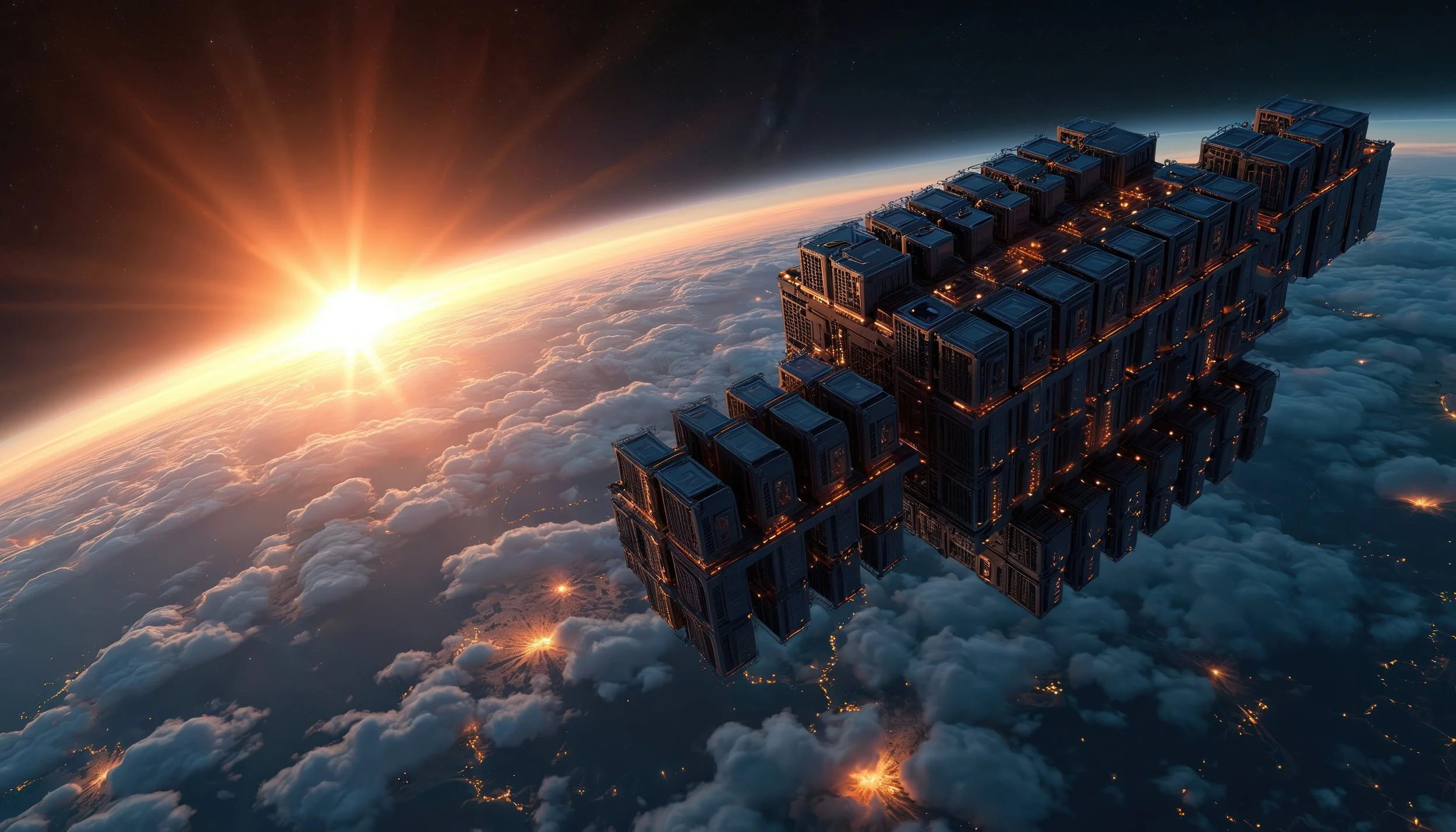
And perhaps most surprisingly, several organizations have begun exploring orbital data centers.
Yes, data centers in space.
The concept remains experimental, but the fact that serious companies and organizations are studying the possibility tells us something important.
The industry is not assuming that today's deployment model will remain the only option.
It is actively searching for alternatives.
The Space Data Center Question
Orbital data centers face enormous challenges.
Launch costs remain significant.
Equipment must survive radiation and extreme conditions.
Maintenance is difficult.
Latency considerations limit certain applications.
Power generation and heat management require entirely new approaches but are eased by solar and space temperatures itself.
There is no guarantee that orbital computing will become economically viable.
But that may not be the most important takeaway.
The important takeaway is that the industry is investing resources into finding solutions that bypass many of the challenges currently facing terrestrial data center development.
Whether the future involves orbital facilities, offshore computing platforms, modular nuclear-powered campuses, or some entirely different approach, the direction is clear.
Technology is looking for alternatives.
Could Today's Data Centers Become Obsolete?
Probably not.
At least not entirely.
The demand for computing is growing so rapidly that most facilities being built today will likely remain useful for many years.
Data centers are expensive, long-term investments, and many will continue serving critical functions well into the future.
However, the assumptions behind today's projects may not age as well as some expect.
The history of technology is filled with examples of infrastructure that seemed indispensable until innovation changed the equation.
The question is not whether data centers will remain important.
The question is whether the optimal location, design, energy source, and operating model for data centers will look the same five, ten, or fifteen years from now.
History suggests the answer is probably no.
A Lesson for Economic Development
This discussion extends beyond data centers.
It highlights a broader lesson that local governments, planners, and economic development professionals should consider.
When communities oppose a particular form of development, they often assume they are influencing whether something happens.
In reality, they may only be influencing where and how it happens.
Technology rarely stands still.
Markets rarely stop searching for solutions.
Innovation rarely waits for universal approval.
Instead, technology adapts to constraints.
It engineers around obstacles.
It finds new opportunities.
It finds another path.
The communities that recognize this reality may be better positioned to prepare for the future than those focused solely on preserving the present.
Because whether the next generation of computing infrastructure ends up in industrial parks, beside nuclear reactors, floating offshore, or orbiting hundreds of miles above Earth, one thing seems certain:
The demand for computing is not going away.
And technology has never been particularly good at taking no for an answer.
More from Scott Turnmeyer
I write about photography, business, mindset, bowling, and the bigger questions that don’t always have easy answers. You can explore more articles, photography, and projects here:
Blog Home
About Scott Turnmeyer
Fine Art Photography
Photography Workshops & Experiences
Digital Consulting