
What Is a Destination Management Organization?
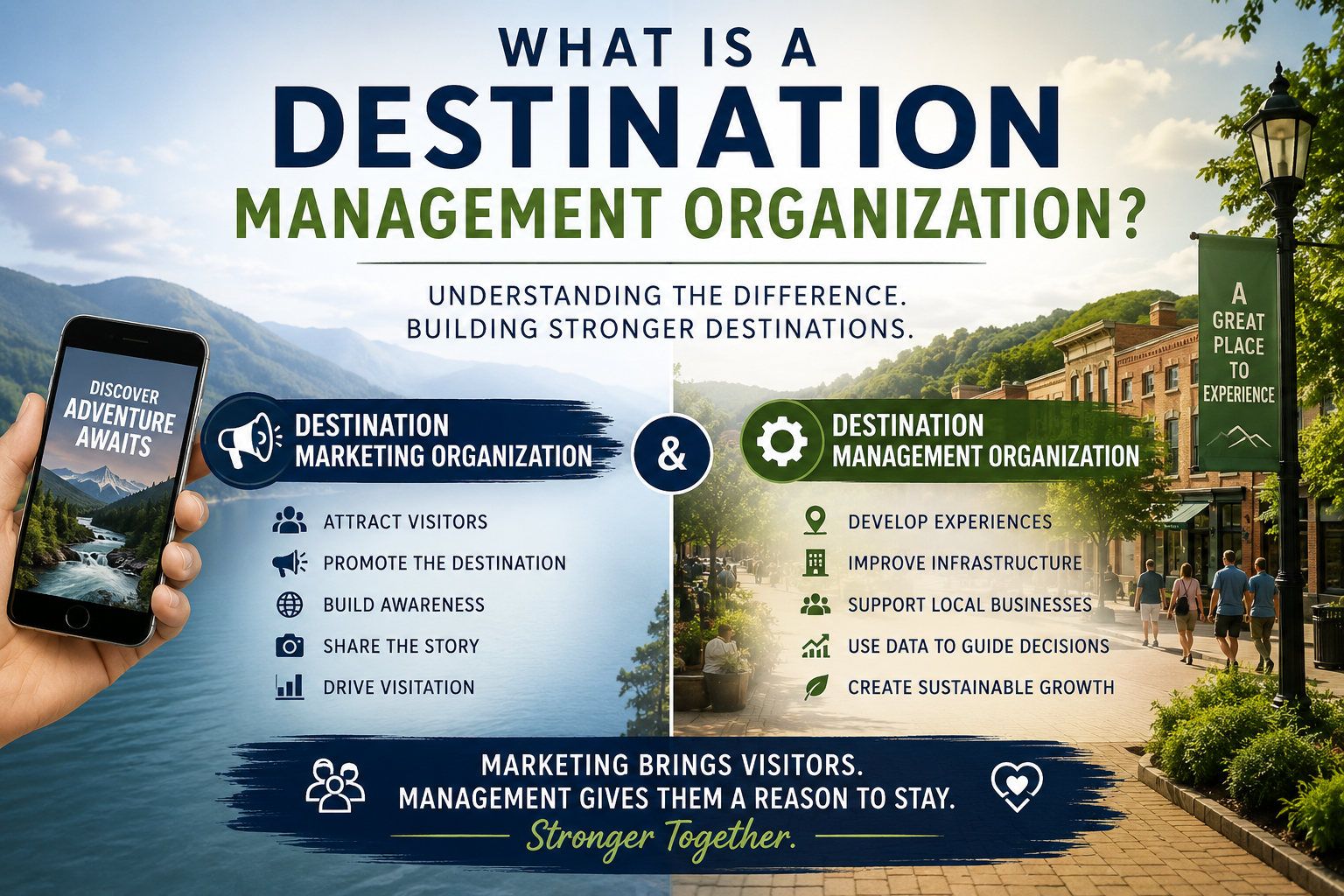
For years, the tourism industry has used the acronym DMO to describe a Destination Marketing Organization—the organization responsible for attracting visitors through advertising, branding, public relations, social media, visitor guides, websites, and other marketing efforts.
Today, however, many communities are beginning to use the same acronym to describe something much broader: a Destination Management Organization.
While the terminology continues to evolve across the industry, I believe separating these two roles creates a much clearer picture of what it actually takes to build a successful destination.
One organization markets the destination.
The other helps build it.
The two work together, but they are not the same job.
The Destination Marketing Organization
A Destination Marketing Organization focuses on one primary objective:
Convincing people to visit.
Its work is outward facing and customer focused.
Typical responsibilities include:
Destination branding
Advertising campaigns
Social media marketing
Public relations
Visitor guides and maps
Website management
Search engine optimization
Event promotion
Visitor information centers
Travel media and influencer relations
Cooperative marketing with local businesses
These organizations are the storytellers.
They identify what makes a destination unique and communicate that message to potential visitors. Their success is often measured through website traffic, marketing reach, visitor inquiries, campaign performance, lodging occupancy, and visitor spending.
Without effective marketing, even an incredible destination can remain undiscovered.
But marketing alone doesn't create memorable experiences.
The Destination Management Organization
A Destination Management Organization focuses on a different question:
Once visitors arrive, what kind of experience are we creating?
This work is much less about advertising and much more about developing the destination itself.
Destination management is about improving the product that marketing is selling.
Responsibilities often include:
Destination development
Visitor experience planning
Wayfinding improvements
Downtown vitality
Attraction development
Public space enhancements
Trail and recreation planning
Tourism infrastructure
Business collaboration
Data analytics and visitor research
Long-term tourism strategy
Resident engagement
Sustainable tourism practices
Rather than asking how many people visited, destination management asks deeper questions:
Did visitors stay overnight?
Did they explore multiple areas of the community?
Did local businesses benefit?
Will they recommend us?
Will they come back?
What experiences are we missing?
What investments create the greatest return for residents and visitors alike?
Those are destination management questions.
Marketing Can't Fix a Weak Destination
One of the biggest misconceptions in tourism is believing that stronger marketing alone will solve tourism challenges.
It won't.
Marketing can increase awareness.
Marketing can increase website traffic.
Marketing can even increase first-time visitors.
But if the destination lacks memorable experiences, walkability, attractions, events, great local businesses, or reasons to stay longer, marketing simply brings more people to experience the same limitations.
Eventually, visitors stop talking about the destination.
Reviews become average.
Repeat visitation declines.
The destination has a product problem—not a marketing problem.
Management Makes Marketing Easier
The opposite is also true.
Communities that continually improve their visitor experience naturally become easier to market.
When new attractions open...
When downtown becomes more vibrant...
When local businesses invest in unique experiences...
When public spaces become more welcoming...
When visitors discover unexpected moments worth sharing...
Marketing becomes more authentic because there are more stories to tell.
The destination begins creating its own momentum.
People share their experiences.
Businesses create new reasons to visit.
Visitors become ambassadors.
Great destinations generate great marketing.
Two Teams. One Goal.
I don't believe these functions should compete with one another.
In fact, they should operate as partners.
Marketing identifies the audience.
Management improves the product.
Marketing attracts visitors.
Management gives them reasons to stay.
Marketing generates awareness.
Management creates memories.
Each makes the other stronger.
Communities that invest in only one side are leaving opportunities on the table.
The Future of Tourism
As destinations become more competitive, success will depend on more than advertising budgets.
Visitors are increasingly choosing places that offer authentic experiences, vibrant downtowns, accessible outdoor recreation, unique local businesses, and memorable moments that can't be replicated somewhere else.
That requires intentional destination development.
It requires collaboration between local government, tourism professionals, businesses, nonprofit organizations, and community leaders.
It requires looking beyond annual visitor counts and asking how tourism can improve the destination itself.
Marketing will always be essential.
But in the years ahead, I believe the communities that thrive will be those that recognize marketing is only one half of the equation.
The real opportunity lies in pairing exceptional destination marketing with intentional destination management.
When you build a place people genuinely love to experience, marketing no longer has to convince people to visit.
It simply has to tell the story.
More from Scott Turnmeyer
I write about photography, business, mindset, bowling, and the bigger questions that don’t always have easy answers. You can explore more articles, photography, and projects here:
Blog Home
About Scott Turnmeyer
Fine Art Photography
Photography Workshops & Experiences
Digital Consulting