
What the Tourism Data Is Telling Us
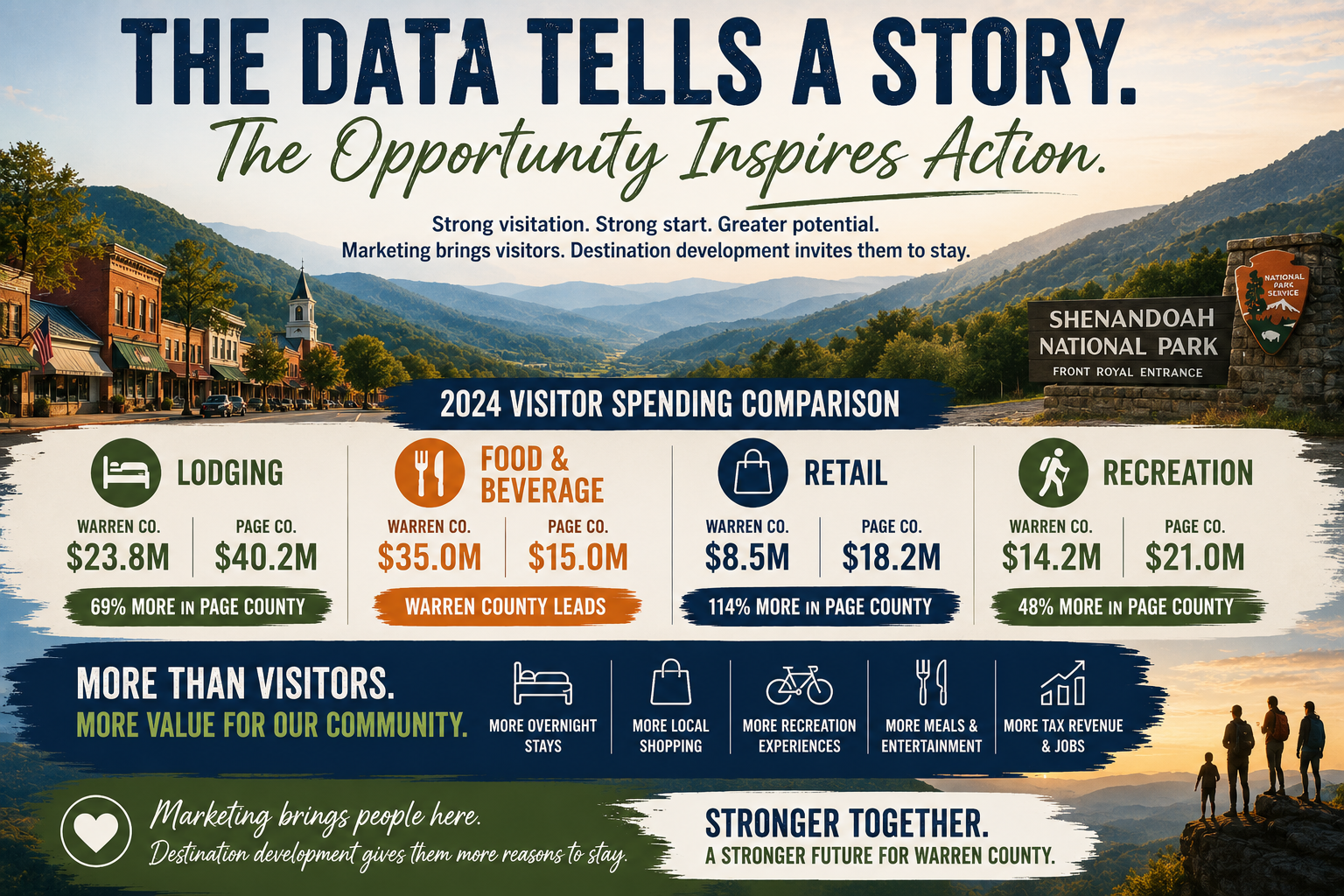
Every once in a while, you come across a set of numbers that make you stop and ask a simple question.
"Why?"
That happened to me recently while reviewing tourism data from Shenandoah National Park, Virginia Tourism Corporation, and neighboring communities.
At first glance, everything looks encouraging.
Shenandoah National Park welcomed more visitors in 2024 than in any of the previous seven years. More than 1.7 million people visited the park, continuing a long-term upward trend.
For communities surrounding the park, that's great news.
More visitors should mean more opportunities for local businesses, restaurants, lodging providers, attractions, and local governments.
But as I dug deeper into the data, one comparison stood out.
Warren County welcomes visitors through one of the busiest entrances to Shenandoah National Park, yet neighboring Page County generates significantly more visitor spending in several key categories.
That isn't a criticism.
It's simply an observation.
And it raises an important question worth exploring.
Following the Numbers
Here's what visitor spending looked like in 2024.
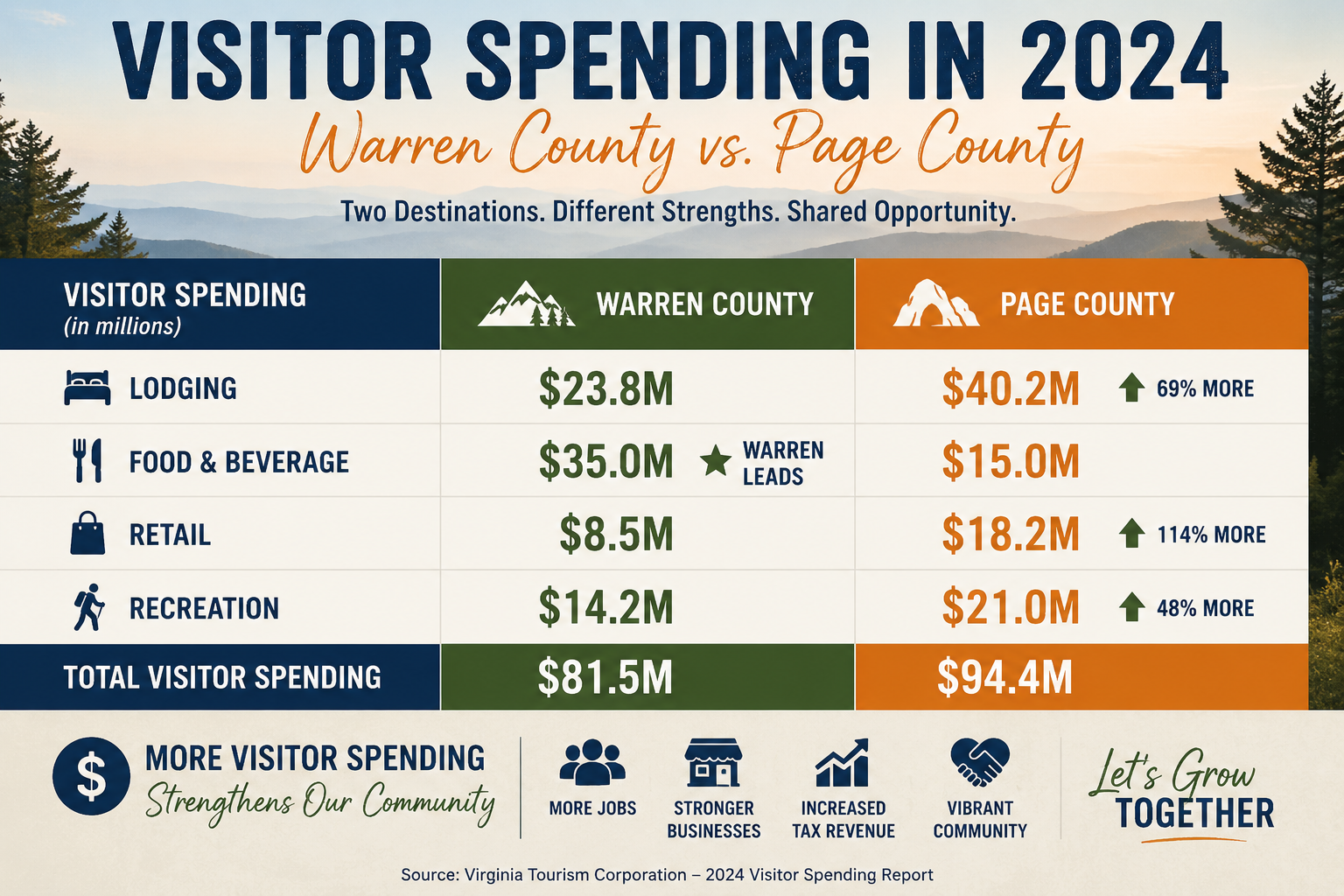
One number immediately jumps off the page.
Warren County generates more than twice the visitor spending in food and beverage.
That's a real strength.
At the same time, Page County generates substantially more spending on lodging, recreation, and retail.
Those differences don't necessarily mean one destination is doing something right while another is doing something wrong.
Every community is different.
Every visitor is different.
But the numbers suggest that visitors are interacting with each destination differently.
That's worth understanding.
Why This Matters
It's easy to look at tourism spending as just another economic statistic.
It isn't.
Every additional dollar spent by a visitor flows through the local economy.
It supports restaurants.
Retail stores.
Hotels.
Outdoor outfitters.
Employees.
Small business owners.
It generates sales tax.
Meals tax.
Lodging tax.
Business revenue.
Jobs.
In other words, tourism spending isn't just about tourism.
It's about strengthening the local economy.
One Number Caught My Attention
As I continued comparing the data, another statistic stood out.
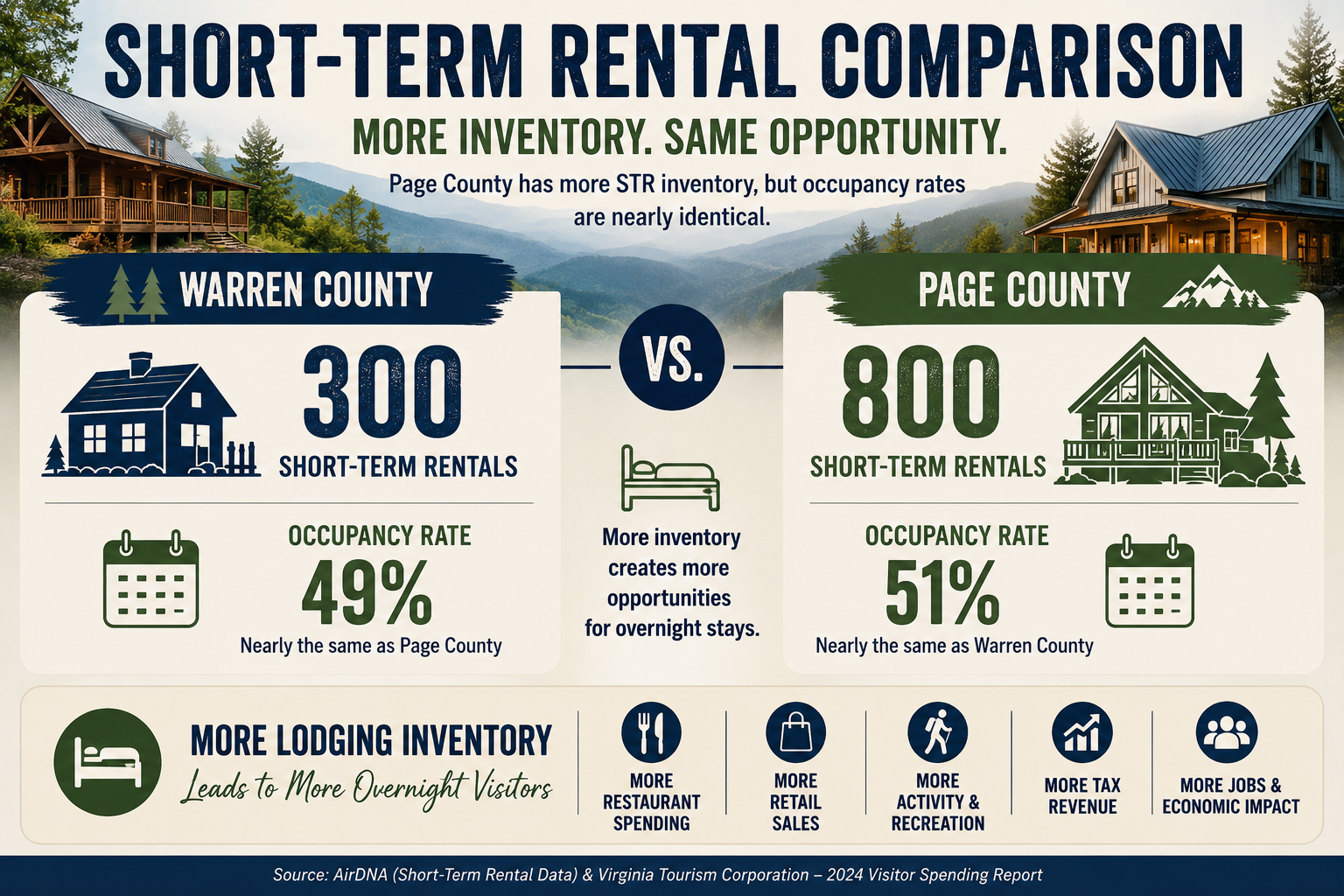
Page County has approximately 800 short-term rentals.
Warren County has roughly 300.
Interestingly, occupancy rates are almost identical.
Page County averaged approximately 51% occupancy.
Warren County averaged approximately 49% occupancy.
That suggests the difference isn't necessarily that one destination is filling rooms more effectively.
One destination simply has significantly more rooms available to sell.
More lodging creates more overnight visitors.
And overnight visitors typically spend more money.
They eat breakfast before leaving.
They browse downtown shops.
They book recreational activities.
They visit additional attractions.
They often return.
One extra night creates multiple opportunities for additional spending throughout the community.
Looking Beyond Marketing
When people hear discussions about tourism, the conversation often turns immediately toward marketing.
How do we attract more visitors?
How do we advertise more effectively?
How do we increase awareness?
Those are important questions.
Destination marketing plays a vital role in every successful visitor economy.
Without effective marketing, many visitors never discover your community in the first place.
As destinations become increasingly competitive, continuing to invest in strong tourism marketing remains essential.
But as I looked at these numbers, I found myself asking a different question.
What happens after visitors arrive?
Marketing can inspire someone to visit Warren County.
It cannot build another boutique hotel.
It cannot create additional lodging.
It cannot open a new outdoor recreation business.
It cannot develop evening events downtown.
It cannot create guided river experiences or photography workshops or locally owned retail businesses.
Those are examples of destination development.
And those investments give visitors more reasons to extend their stay once marketing has successfully brought them here.
The Opportunity
One of the most encouraging things about this data is that it doesn't suggest Warren County lacks visitors.
Quite the opposite.
The Front Royal entrance remains one of the busiest gateways into Shenandoah National Park.
People are already coming here.
That means our opportunity may not simply be attracting more visitors.
It may be creating more opportunities for the visitors we already have.
More overnight stays.
More recreation.
More shopping.
More experiences.
More reasons to spend one more evening before heading home.
Imagine the Possibilities
Imagine Warren County five years from now.
More boutique lodging.
Additional cabins and short-term rentals.
Expanded river recreation.
Guided hiking experiences.
Photography workshops.
Evening concerts downtown.
Seasonal festivals.
Locally owned businesses creating products visitors can't buy anywhere else.
New outdoor recreation businesses.
Every one of those investments gives destination marketers another story to tell.
Every new experience becomes another reason for someone to choose Warren County over another weekend destination.
Marketing becomes stronger because the destination itself becomes stronger.
Working Together
Sometimes conversations about tourism unintentionally create the impression that destination marketing and destination development compete with one another.
I don't believe that's true.
In fact, I believe they're partners.
Marketing brings visitors through the front door.
Destination development gives them reasons to stay.
The stronger the destination becomes, the easier it is to market.
The stronger the marketing becomes, the more visitors arrive to experience what has been created.
One supports the other.
The Bottom Line
The data doesn't tell us everything.
But it does tell us enough to ask thoughtful questions.
How do we encourage more overnight stays?
How do we create additional recreation opportunities?
How do we help visitors discover downtown businesses?
How do we encourage visitors to spend another day exploring everything Warren County has to offer?
Those aren't marketing questions.
They aren't planning questions.
They aren't economic development questions.
They're community questions.
And the answers don't require us to choose between destination marketing and destination development.
The communities that thrive over the next decade will likely be the ones that continue investing in both.
Because attracting visitors is only the beginning.
The real opportunity is creating a destination that makes them want to stay.
More from Scott Turnmeyer
I write about photography, business, mindset, bowling, and the bigger questions that don’t always have easy answers. You can explore more articles, photography, and projects here:
Blog Home
About Scott Turnmeyer
Fine Art Photography
Photography Workshops & Experiences
Digital Consulting